Plutonia Blue: A Conversation with Jewelry Designer Mia Giselle Anter
The Brooklyn-based artist and founder of cult jewelry line Plutonia Blue talks ancient symbolism, perfect New York days and the power of slowing down.
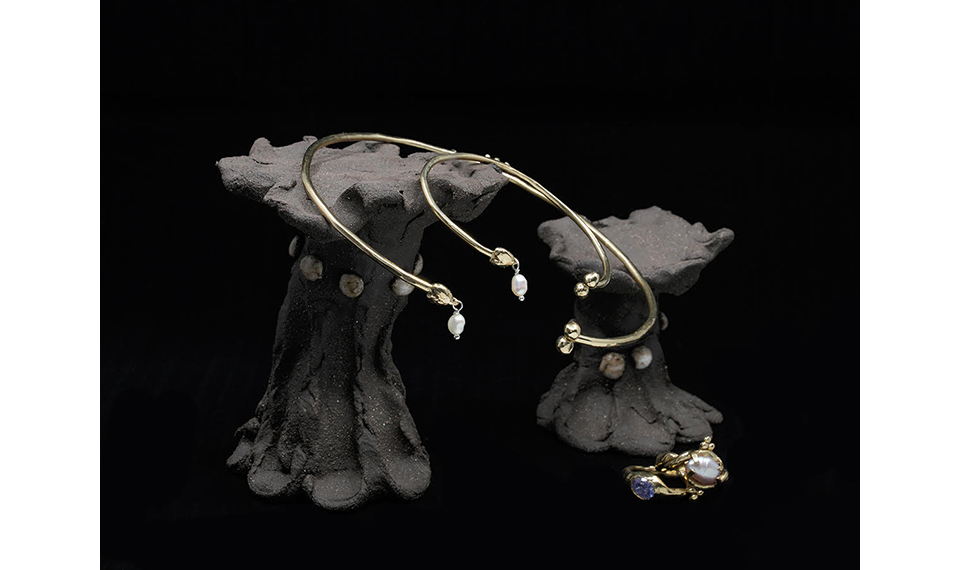
Plutonia Blue is the jewelry line founded by Istanbul-born, Brooklyn-based artist Mia Giselle Anter—whose pieces feel less like accessories than talismans. Hand-forged in brass and sterling silver and often embedded with natural elements, her work draws on ancient symbolism and personal mythology. Each piece bears the trace of its making—hammered, scorched, shaped by hand—and has earned a devoted following among artists and performers, including Caroline Polachek, who gravitate toward jewelry that is not only beautiful but charged with meaning.
We sat down with Mia to talk about the psychic terrain that shapes her work, the lasting influence of Istanbul on her aesthetic, and the slow, intentional process behind some of our favorite pieces being made in New York right now.
Hillary Sproul: When did you first discover your love of jewelry?
Mia Giselle Anter: I’ve been making jewelry in some capacity since I was a teenager—mostly reworking vintage pieces of Afghan jewelry I’d find at the Grand Bazaar in Istanbul. I still have the necklace I made for my junior year Homecoming—a massive collar made of iridescent Czech glass and antique brass chain. In 2013, I followed an intuition and moved to New York to become a metalsmith. I’ve been working with this medium for over a decade, and it continues to surprise and challenge me.
HS: Was an interest in mythic and ancient symbolism always a part of your psyche?
MGA: I would say my interest has always been in the psychic terrain itself. I’m interested in how personal mythologies are made manifest in the mind—the latent imagery and symbolism of the unconscious, and the process of unearthing, unraveling, and examining what it yields. What I love about the symbolic is that every individual has their own relationship to, and associations with, what they encounter. As I move toward more abstracted forms in my work, possibilities for meaning-making (and un-making) continue to expand.
HS: How has Istanbul shaped your aesthetic and the symbolic language in your work?
MGA: The first metal object I remember falling in love with was the alem—the crescent finials that adorn the tops of mosques and minarets all over the city. Much of the more literal symbolism in my work can be traced back to my childhood in Istanbul—where the Old World is very much alive in the present landscape. Crescents, evil eyes, architectural decay, and Anatolian anthropological findings all make their way into my pieces.
HS: What are some of the first pieces you made that you really loved?
MGA: One of the first pieces I fabricated in metal back in 2013 was a collar of black scallop shells I collected in the Rockaways, set in brass prongs on thick brown deerskin cord. The Crescent Spike ring will always be close to my heart—I wore a pair of them every day for many years. Both of these pieces feel old beyond their years, and though both motifs remain in my work, they’ve evolved into bolder, more severe representations of those initial formations.
View this post on Instagram
HS: Is there a piece from any of your collections that you’re really proud of?
MGA: I don’t often release collections because I’m a big believer in slowing things way down. Slow creation slows mindless consumption and engenders intentionality in what we choose to purchase and choose to treasure. One of the only true collections I released was last year, as a sort of capsule, and it happened quite organically. I was reading a lot of Anaïs Nin, Anne Carson, and Bataille—and ended up creating a series of pieces as an ode to Eros: sensuality writ in metal. The Phallus Torque is a piece I adore because it is discreet but oh-so horny! A very dear friend of mine chose to wear it to her wedding before realizing what that little pearl drop was.
HS: Beyond mythology, what (or who) are some of your biggest aesthetic inspirations?
MGA: Louise Bourgeois, Leonor Fini, Carolee Schneeman, Pina Bausch, Isamu Noguchi, Antoni Tàpies, Rebecca Horn, and Alexander Calder.
HS: Who are your personal style icons?
MGA: Any character in a Parajanov film. In a Pasolini film. In a Jodorowsky film. In a Helmut Newton photograph. The wild, risk-taking, beautiful, playful, chic, and free elders that roam around this great city.
HS: Any favorite clothing designers right now? (Ideally, to pair with your fine jewels).
MGA: Dilara Findikoglu, Beaufille, Cawley, T Label, Sarah O Robinson, and Bode.
HS: Where do you shop in NYC?
MGA: Graceland, 10 ft Single by Stella Dallas, Tokio7, The Frankie Shop, and Tumbao World.
HS: What are some of your favorite aesthetic spaces in NYC?
MGA: Elizabeth Street Garden, The Met Cloisters, the Rose Reading Room at NYPL, Noguchi Museum, Neue Galerie, The Bowery Hotel, Russian Samovar, Swan Room, and the Soho Grand.
HS: What does a perfect New York day look like for you?
MGA: This is a very unpopular opinion, but I love the colder months in NYC! I typically rise before the sun and move through my mornings by candlelight, make coffee, and get back in bed to read. Cultivating languor is crucial for my sanity — especially because a lot of my work involves running all around the Diamond District carrying heavy metal and dodging tourists.
A truly perfect day would involve a long, long drift. I love the walk from Ridgewood to the waterfront in the Financial District — the old architecture and winding cobblestone streets are particularly beautiful in winter. A pit stop at Conwell Coffee Hall to rest and regroup, then continuing on to the West Village. IFC matinee (preferably not in the tiny screening room), followed by an early solo dinner at Minetta Tavern — dirty Ketel One martini and filet mignon.
My grandmother always said no company is better than bad company — but I’d argue no company is sometimes better than even the best company. Romanticize everything! Especially solitude! Truly perfect days must leave room for gallery shows I might’ve missed, bookstores, unexpected encounters, and other side quests. This city will grind you down, hard and often, but just one perfect day will make you fall in love with it all over again.
WORDS Hillary Sproul
PHOTOGRAPHY Courtesy of Mia Giselle Anter