Nocturnal Conditions: An Interview with Designer Andrew Curwen
By Hillary Sproul
Andrew Curwen is an emerging New York-based fashion designer whose work operates in a distinctly psychological and emotionally charged register. A Parsons School of Design graduate with experience under Elena Velez and Jane Wade, he blends corsetry, sharp tailoring, and distorted silhouettes into what he describes as a kind of “romantic violence.”
His Autumn/Winter 2026 debut, Nocturnal Conditions, marked his arrival on the New York Fashion Week calendar, introducing a dark, handcrafted world rooted in tension and transformation. For Curwen, the title points to a kind of freedom—when the world quiets, expectations fall away, and something more instinctive can surface—an idea shaped by his interest in what exists just outside dominant rhythms.
Born in Lake Placid, he grew up moving constantly as part of a military family. This sense of impermanence led Curwen to turn inward early, building his own internal world—one that continues to inform his work, even as it now finds expression on a larger stage.
We sat down with Curwen to learn more about the emotional language behind his designs, the push and pull between structure and release, and the world of Nocturnal Conditions.
Fashion isn’t widely thought of as a particularly emotional creative practice, but you describe your work as having a “dramatic, emotionally charged design aesthetic”. When did you first recognize that fashion could also be a channel for emotional exploration?
It was always there for me. I don’t think I ever saw fashion as separate from emotion. In fact, I don’t think I would have been interested in it at all if it had felt purely commercial, purely consumptive. That side exists, of course, but it’s never been what pulled me in.
My earliest encounters with fashion were incredibly emotional, almost like being struck by something. Like moments from the film Singin’ in the Rain, that “Beautiful Girl” sequence, moving through time… or My Fair Lady, the race scene! I still die for those silhouettes. It was the first time I really felt clothing, not just saw it. And even more personal things, like seeing my aunt’s wedding dress as a child. That was quite overwhelming, actually. Encountering a garment like that in real life—the weight of it, the moment.
So for me, fashion and emotion have always been completely intertwined. It’s both what something looks like, and it’s about what it does to you, what it stirs, and what it reveals.
View this post on Instagram
What emotions do you feel you tend to play with in your work or try to evoke in both the wearer and viewer?
I think of the wearer and the viewer as having very different experiences. For the wearer, it’s quite intimate. I want them to feel protected… understood, even. Not in a performative way, not about being seen by everyone else—but seen by me. The clothes should feel like an extension of who they are, or perhaps who they’re becoming. There’s a kind of quiet strength in that. People overuse that word, “strength,” but clothing is our first layer of defense and also our first form of communication. It has to hold you, in every sense. A lot of what I explore comes from that pull, what it feels like to not be seen properly, to have something internal that doesn’t quite translate. Fashion, for me, becomes a way of giving form to that; of making the invisible visible. I’m very interested in vulnerability, but not as something fragile—as something honest and defiant. It takes strength to wear that openly.
The viewer is different. They don’t have to understand it, but they should feel something. I have no interest in neutrality. There’s too much of this sort of polished indifference, this cultivated apathy, and I find it deadening. Fashion should provoke, seduce, disturb, scream—whatever it needs to do—but it should never leave you untouched.
You talk about clothing becoming part of someone’s lived narrative—what does that look like in real life? How does a garment actually change someone’s behavior or sense of self?
Clothing becomes part of someone’s lived narrative when it stops feeling like something you put on and starts feeling like something you are. It becomes a kind of uniform, not in the literal sense, but in the way it aligns with how you see yourself… or how you’re trying to see yourself. I’m not interested in people wearing something as an association or reflection of my brand. It has to integrate into their life, their identity. When someone connects with a piece, really connects with it, it shifts how they carry themselves. It’s no longer just an outfit for an evening—it becomes personal, almost ritualistic.
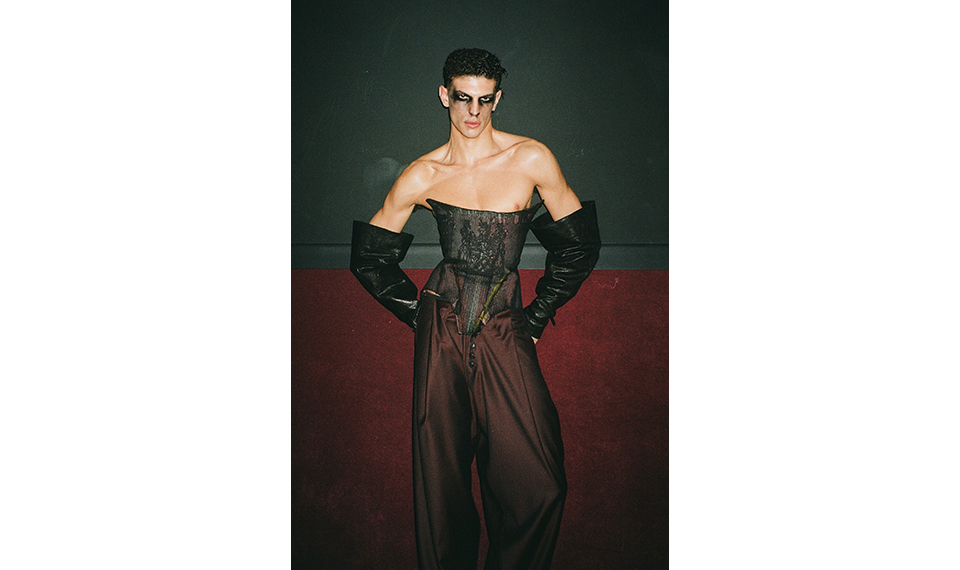
That’s why I’m so drawn to corsetry and tailoring. They physically transform the body. You put them on and your posture changes immediately—you stand differently, you occupy space differently. There’s a discipline to it, but also a revelation. You start to uncover a version of yourself that perhaps was always there, just not expressed. And when that becomes part of your everyday life, that’s when a garment moves beyond product. It becomes something with memory, with weight. Almost like an heirloom or a relic. To be part of someone’s life in that way, it’s profound.
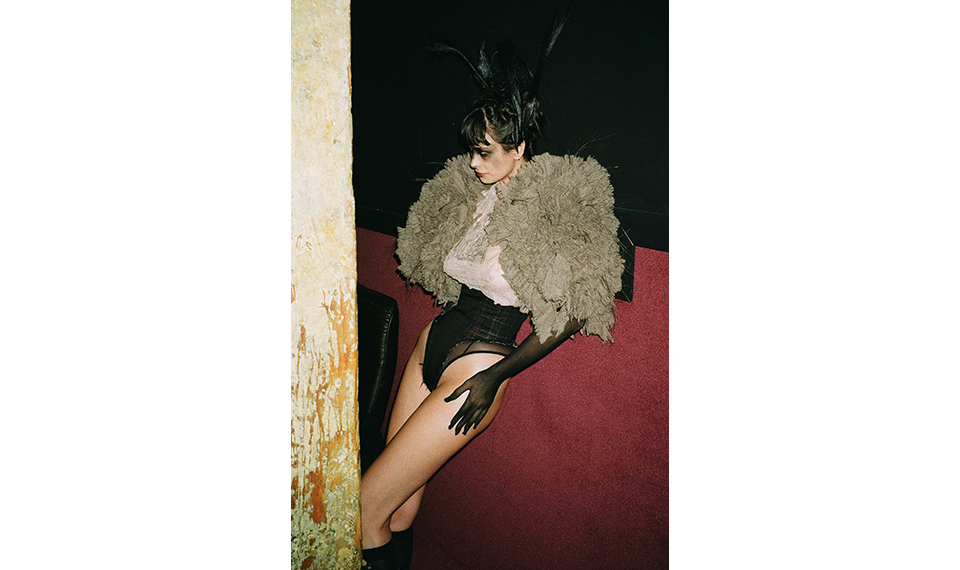
Your silhouettes literally reshape the body—cinched waists, exaggerated shoulders. In a way, you’re rejecting the oversized silhouette that’s taken hold the past several years. Has this always been a preference, or do you feel it’s a reaction to what we see on the streets?
It likely comes from the way I started. I was draping on the body long before I learned to draft a pattern properly. It was instinctive, working in three dimensions, shaping directly onto a form. You develop a kind of sensitivity to the body that way. So naturally, I think I’ve always been drawn to silhouette in a more intimate sense, cutting into the body rather than building away from it. There’s a power in that: in defining a line, in controlling proportion so precisely.
But I wouldn’t say it’s a reaction to what’s happening more broadly. Fashion moves in cycles, and there’s incredible work being done in volume, in exaggeration, in things that sit far away from the body. I find that just as interesting. And I don’t believe in fixing myself to one idea. The moment you say, “this is what I do,” you’ve already limited yourself. I might be obsessed with structure and containment now and completely contradict that next season.
Your first NYFW show was accompanied by a poem you wrote called “Sonnet No. 2”. Beyond poetry, there is such a grand sense of drama and narrative to your work. In some ways, do you see yourself as more of a storyteller than designer?
In an honest sense, yes. I do think of myself as a storyteller. The reality of high fashion is that most people will encounter the work through image, through the narrative of the show, rather than through direct physical interaction with the garments. That’s simply the nature of the industry. You’re often constructing an image as much as you are constructing clothing.
But I don’t see that as separate from design. The design process is the language I use to tell those stories. I’m not someone who finds writing particularly easy, so the garment becomes the most direct and precise way for me to communicate ideas. That’s also the joy of high fashion: that you are able to weave stories, drama, even a kind of mythology. It’s a rare form of entertainment that exists as an image, as well as in the physical world. There is still a tangible object, something that carries weight and presence, that holds those ideas.
So while image is undeniably a huge part of it, there is still a physical reality to these stories, these narratives, these constructed worlds. And being able to build that—something that exists both as fantasy and as an object—is, for me, one of the most fulfilling parts of what I do.
Who inspires you in the fashion world?
Isabella Blow is a huge inspiration for me. What I’ve always admired is the depth of her relationship with fashion; not as something she consumed, but something she lived. There’s a photograph of her walking her dogs outside her country house. She didn’t need to be dressed in any particular way, but she would still put on a Philip Treacy hat and an Alexander McQueen coat before leaving the house. Beneath that, she’s in only underwear, but those two pieces were essential. They were what allowed her to feel fully herself, even in the most private, ordinary moments. I find that incredibly beautiful. Beyond that, her impact on the industry is immense. She championed and nurtured an entire generation of designers at a time when the industry was becoming increasingly commercial. She carved out space for artists, for people with real vision, and in doing so helped shape what I consider a golden era in fashion.
André Leon Talley is equally important to me. He carried the same intensity of love for fashion; an absolute devotion to its language, its history, its storytelling. He had this extraordinary ability to read designers’ work not just as clothes, but as narratives, and to communicate that beauty outward with such clarity and conviction. And he did so within an industry that was not always generous to him—which makes his generosity toward it even more remarkable.
Both he and Isabella wore clothing in a way that felt completely sincere. There was nothing performative about it. It wasn’t branding, it wasn’t strategy—it was devotion. They were like birds of paradise in the way they presented themselves, but it was always rooted in truth. I, unfortunately, never got to meet either of them, but they’re both present for me in different ways. They represent a fearless, irrevocable love for fashion, one that is unembarrassed, uncompromising, and deeply human.
How has New York shaped you?
It’s the place I consistently return to—and since moving back in 2013, it’s the longest I’ve ever lived anywhere. I love it. New York has shaped me in a very direct way. It was the first place that made me feel both overwhelmed and completely awake at the same time. There’s a rawness to it. It’s not a city that allows you to be passive, constantly pushing you into movement, into participation. And I think that’s been very formative for me: this idea that you have to actively define your own space within something so vast.
It reminds me of a moment in Through the Looking-Glass, when the Red Queen grabs Alice and they begin running together. Alice is confused because, despite all the effort, they don’t seem to move forward at all. She stops and says something about feeling exhausted and that they’ve gone nowhere. And then the Red Queen says, “Now, here, you see, it takes all the running you can do, to keep in the same place”. That idea has always stayed with me in relation to New York. You have to keep moving just to maintain your position—and if you want to move forward, you need to run twice as fast.
But New York is also home to some of the most extraordinary people. You’re living among people with completely different backgrounds, cultures, ambitions, and identities, all in close proximity. It makes it very difficult to exist in an echo chamber. You’re constantly being challenged, inspired, or redirected by the people around you. The community I’ve found here has been one of the greatest blessings in my life, both personally and professionally. New York has made me strong. And the people I’ve found in New York have made me stronger still.
Who are your New York icons?
New York is filled with icons. That’s part of its nature. We can’t see the stars in the night sky because here they walk among us. One night in 2018, I was at a wine bar in the West Village, a little drunk, and I noticed this older woman sitting alone. Dark, short hair, very composed, incredibly striking. I was convinced she was Liza Minnelli. I went over and started chatting, never directly asking if she was Liza, but I definitely steered the conversation in that direction. We ended up sharing a couple of glasses of wine and having this beautiful, meandering chat. She told me stories that, in my mind, only reinforced the idea that this was, in fact, Liza. Stories about being around Andy Warhol, about hanging out at The Factory, partying at Studio 54, about a life that felt deeply entangled with that world. By the time I left, I was completely convinced. I went back to my friends and said, “That was Liza Minnelli.” And they were like, “No, bitch, it definitely wasn’t.”
But to this day, I’m not entirely sure it matters. Whoever she was, she was extraordinary. She had lived a life that intersected with something larger than herself, and she carried it with complete ease. That, to me, is what New York produces constantly. People who are deeply embedded in cultural history. And that’s why I say New York is filled with icons. I think of people who have actively shaped the cultural language of the city. Figures like Andy Warhol, Candy Darling, and the club kids of the ’90s—people like Amanda Lepore, who helped define entire eras of self-expression and nightlife culture. There’s also someone like Bill Cunningham, who documented New York with such clarity and devotion. His eye felt inseparable from the city itself—raw, observational, and with love.
And then there are the quieter icons, the people who are not necessarily known globally, but who are absolutely central to your own world within New York. For me, that includes my oldest friend, Anthony Fernandez. He was born and raised in the East Village, and I’ve known him since I was 10. He’s one of those rare people who feels completely embedded in the fabric of a place. When you walk through the East Village or Lower East Side with him, it’s like moving through a living map—everyone knows him and he knows everyone. That kind of presence is very specific to New York. He has this instinct to show up for people, in whatever way he can, without hesitation. And I think that’s why downtown responds to him so strongly—he’s helped so many people, often in very quiet, unspoken ways.
He’s also an extraordinary creative force. He works across lighting design and production (he does the lighting for my shows), but he also works in theatre, and is deeply connected to the New York stage world. And then, on top of that, he’ll also be building houses, or skiing in Japan, or moving between completely different worlds with complete ease. There’s something about that kind of fluidity that feels very New York to me, this ability to contain multiple lives within one person, without needing to separate them. To me, that’s icon behavior.
WORDS Hillary Sproul
PHOTOGRAPHY Andy Martinez