Downtown Lens: The Photographers Who Captured It All
Curated by author and nightlife legend Richard Boch, a new exhibition at The Gallery at Soho Grand features iconic works from 20 storied photographers who captured the raw energy of 1970s and '80s New York. Ahead of the opening, Boch speaks to some of the visionaries behind the lens.
New York City in the 1970s and ’80s was a bounty of riches and unexplored territory in various states of wonder and decay. Along with new faces, sounds, and dreamscape visions, the city offered a scattershot array of possibility, clamoring for what was next. The nights were calling and tomorrow was calling too—while patience was an unfound virtue, replaced by a hunger that knew no bounds. Downtown, or anywhere south of Union Square, was both location and vibe: a wild inversion of night and day that began sometime around midnight and never seemed to end. Did we ever once consider, or even notice, that we were watching history unfold—or was that simply realization in retrospect?
The opportunity to choose a collection of images for the current exhibition, Downtown Lens, at The Gallery at Soho Grand, stands as a testament to both the eye of the photographer and the richness of subject matter that existed during those vitally important decades. These photographs have become both a history and a memory of the city we love.
The Lower East Side, the Bowery and the Alphabets were on fire, experiencing an unforeseen readiness for that moment of what’s next. Max’s Kansas City and CBGB shared ground-zero status while Max’s founder Mickey Ruskin stretched the boundaries of cool thirty blocks south when he opened the Lower Manhattan Ocean Club on Chambers Street in 1976. Shortly after, in the fall of 1977, I made a home for myself in a loft on Murray Street, taking the pioneer spirit of downtown a few blocks further south. Everything happened fast, and it wasn’t long before I was standing on what seemed like a loading dock, but in reality was the front steps of a club on White Street.
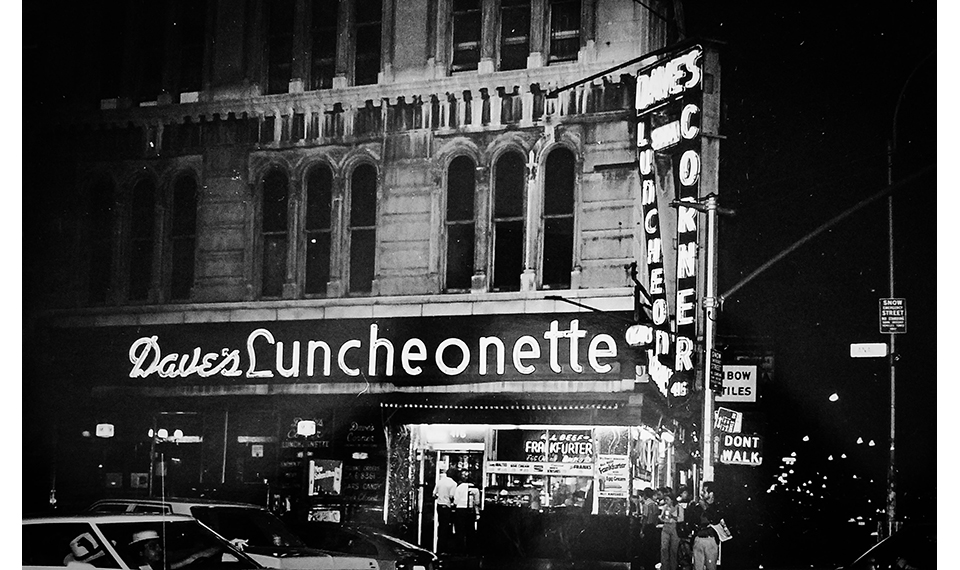
Dave’s Luncheonette at Night, 1980. Photo by Lisa Genet
The club itself was a slightly oversized hole-in-the-wall—Chinatown-adjacent, in the area that was slowly becoming Tribeca. It was late winter 1979, I was the Mudd Club doorman and the 1980s still seemed a distant future.
Money soon followed the art, and the music, to those neighborhoods that existed somewhere between the last gasp of Bohemia and a new frontier. Allan Tannenbaum, who had already made his home downtown, likes to say, “Antonioni’s 1966 film Blow-Up, with its depiction of a photographer’s life in Swinging London, was an era that greatly inspired me to become a professional photographer.” Whenever I ran into Allan, he was camera in hand and for that, I’m forever grateful.
The photographs of Bob Gruen add another degree of next-level imagery to the history of a culturally significant era. When asked what made taking pictures in the 1970s and ’80s different and remarkable, Bob shared this: “John Lennon once said that if he had lived in Roman times, he’d want to be in Rome—and by 1972, Lennon felt that New York City was the center of the creative world, so he moved here. It was an exciting time when artists of all kinds met downtown and inspired each other.”
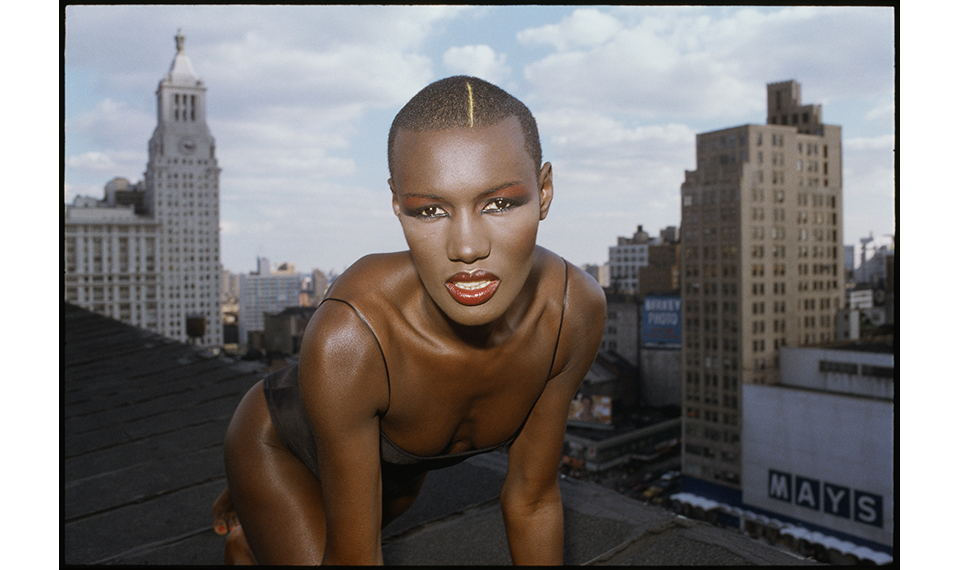
Grace Jones, NYC, 1978. Photo © Kate Simon
The great Kate Simon, whose photographs I’ve come to know and love, lays it all on the table when she speaks of a time in the 1970s and ’80s: “When the geniuses walked the Earth, and NYC was their home. As a photographer, you were spoiled for choice.” That being said, Kate spoiled us with the incredible choices she made.
Whether it was on the street, in the clubs, or in our own homes, downtown was an incubator for new and radical genius. Whether we’re talking Basquiat or Blondie, No Wave, Patti Smith, or Graffiti, it was a deep-dive adventure into the realm of what’s next.
Michael Halsband, whose photographs cover a broad view of culture and life, grew up in New York City, where he still lives and works. We met at the Mudd Club, and our friendship came to be during time spent at Chinese Chance–One University Place, the last of Mickey Ruskin’s legendary art bars. When I asked Halsband about taking photographs in the 1970s and ’80s, he told me, “It seemed like business as usual, no matter what decade. Wandering around the city, walking everywhere, I was trying to avoid trouble while skating on or along the edge. There were always new scenes to discover and people to connect with—revealing more scenes and more people. My career is just a continuation of that same adventure.”
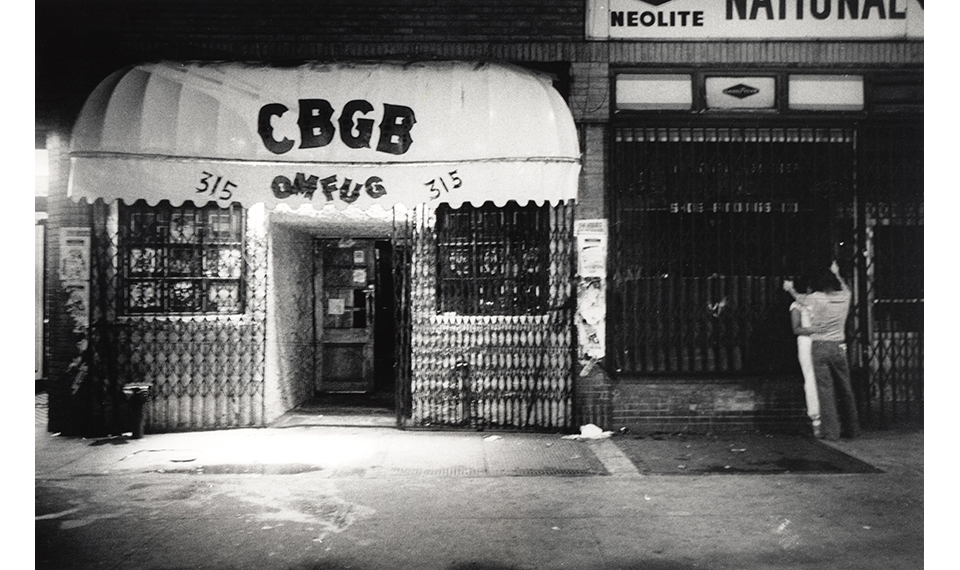
CBGB View, Bowery, 1977. Photo by GODLIS
The photographer Godlis had been taking photos on the street in the East Village since the mid-1970s, staking out a stretch of sidewalk in front of CBGB and bringing his love of Brassaï’s Paris by Night to the Bowery. When I asked what it was like, all he could say was, “We carried our cameras everywhere, film stashed in our bags and pockets, committed to being the ones documenting the best of what we saw.” He didn’t need to say anything else—his photographs say it all.
Where we came from, and what came next—New York City in the 1970s and ’80s was a time of crash and burn and rebirth. Photographer Roberta Bayley recalls, “Taking photos in ’70s New York was exhilarating because the downtown scene was young and new—and there were no rules. Who could ask for more than that? We had no idea the city was crumbling, because to us it was vibrant and exciting.”
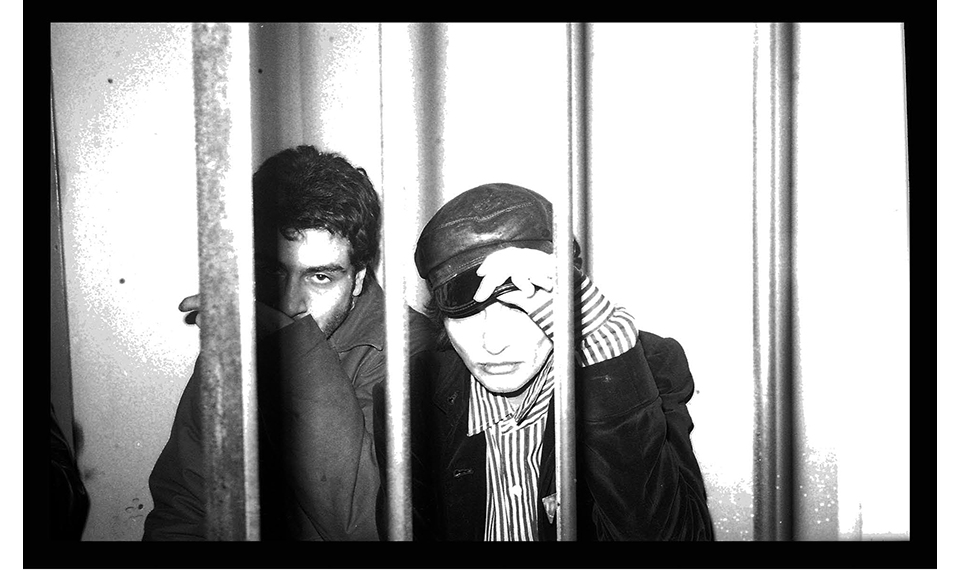
Amos Poe and Mary Lou Green, Mudd Club, 1979. Photo by Nicholas Taylor
There are random occasions when I close my eyes and see the memory of time gone by. Remembering who was there, what was happening, and who had a camera brings those moments into focus. Memory and photography go hand in hand until the memories fade and the photographs reawaken a second-chance connection. The camera grabs hold of those moments—the faces and places we loved and sometimes lost. Though memory often differs from reality, the eye of the photographer and the lens of the camera offer a version somewhere between memory and truth. At that point, it’s up to us whether to stare or turn away—or to blink and rerecord.
We were all living on our own version of the edge—on the cusp of what came to be seen as two remarkable decades—crazy and beautiful and everything in between. Life was in the throes of the fast lane, as everyone moved from the sidelines into the thick of it. Together with twenty visionary photographers whom I came to know, we were experiencing a radical shift in life and culture in New York City. I was a witness while they took the pictures through a Downtown Lens.
***
Downtown Lens
Curated by Richard Boch and the team at Soho Grand
Opening Reception: February 11, 6-8PM
Wednesday – Sunday / Noon to 6PM
Through May 3, 2026
The Gallery at Soho Grand
310 West Broadway, Soho, NYC
***
WORDS Richard Boch
FEATURED IMAGE Keith Haring in his Studio, 1982. Photo by Allan Tannenbaum
Richard Boch writes GrandLife’s New York Stories column and is the author of The Mudd Club, a memoir recounting his time as doorman at the legendary New York nightspot, which doubled as a clubhouse for the likes of Jean-Michel Basquiat, Keith Haring, Debbie Harry and Talking Heads among others. To hear about Richard’s favorite New York spots for art, books, drinks, and more, read his Locals interview—here.